Anubandha First Aid Academy
Hospital emergency response training
For Hospitals

Hospital Emergency Preparedness & Code Blue Readiness

Simulation-based emergency response training for hospitals, nursing homes, ICU teams, emergency departments, RMOs, nurses, and clinical staff.

AFAI helps healthcare institutions strengthen emergency response systems through Code Blue drills, crash cart readiness, simulation-based training, clinical skill reinforcement, and structured debriefing. Our hospital programmes are designed to help teams recognise deterioration early, activate response pathways, perform essential emergency interventions, and work together with confidence when seconds matter.

What we strengthen

One hospital readiness system, built through simulation and drills.

Modular. Measurable. Built for the realities of Indian hospitals.

Code Blue Readiness

Role clarity, activation pathways, team response, and structured emergency drills.

Crash Cart Preparedness

Crash cart orientation, emergency equipment familiarity, drug readiness, and response workflow.

Clinical Response Skills

CPR, airway basics, oxygen therapy, emergency assessment, and recognition of deterioration.

Team Communication

Closed-loop communication, leadership roles, escalation pathways, and crisis resource management.

Simulation-Based Competency

Realistic emergency scenarios, observed performance, structured assessment, and debriefing.

Documentation & Quality Support

Attendance records, skills checklists, drill observation sheets, debrief summaries, and readiness recommendations.

Hospital Emergency Readiness Packages

Choose the engagement depth your team actually needs.

AFAI frames Code Blue as a system: emergency-response strengthening, mock-drill readiness, documentation support, and team preparedness.

Half-Day Code Blue Drill

Best for
Hospitals wanting a focused mock drill and team response orientation.
Includes
Code Blue activation walkthrough; team role allocation; CPR sequence reinforcement; crash cart orientation; short simulation drill; debrief and recommendations.
Suitable for
Nursing homes, small hospitals, daycare centres, speciality clinics, departments requiring rapid orientation.

1-Day Code Blue + Crash Cart Readiness Programme

Best for
Hospitals wanting structured emergency response strengthening.
Includes
Code Blue workflow training; crash cart readiness review; emergency drug orientation; CPR and AED/defibrillator workflow; simulation-based team drills; debrief summary; attendance and participation documentation.
Suitable for
Hospitals, emergency departments, ICU teams, OBGY centres, orthopaedic centres, dialysis units, nursing homes.

3-Month Emergency Readiness Cycle

Best for
Institutions wanting repeated reinforcement rather than one-time training.
Includes
Baseline readiness review; monthly simulation drills; department-specific emergency scenarios; team communication training; skills checklist; drill observation reports; debrief and improvement recommendations.
Suitable for
Hospitals preparing for quality audits, institutions improving Code Blue culture, nursing homes upgrading emergency response systems.

6-Month Jeevan Rakshak Clinical Response Programme

Best for
Institutions wanting long-format clinical response and critical care upskilling.
Includes
Initial patient assessment; vitals monitoring and interpretation; deterioration recognition; oxygen therapy and airway basics; emergency protocols; pharmacology; BLS/ACLS/CCLS-linked concepts as applicable; simulation drills; reinforcement; assignments; assessments; final report and recommendations.
Suitable for
ICU teams, OT teams, ward nursing staff, RMOs, junior doctors, casualty/emergency teams, high-risk clinical departments.

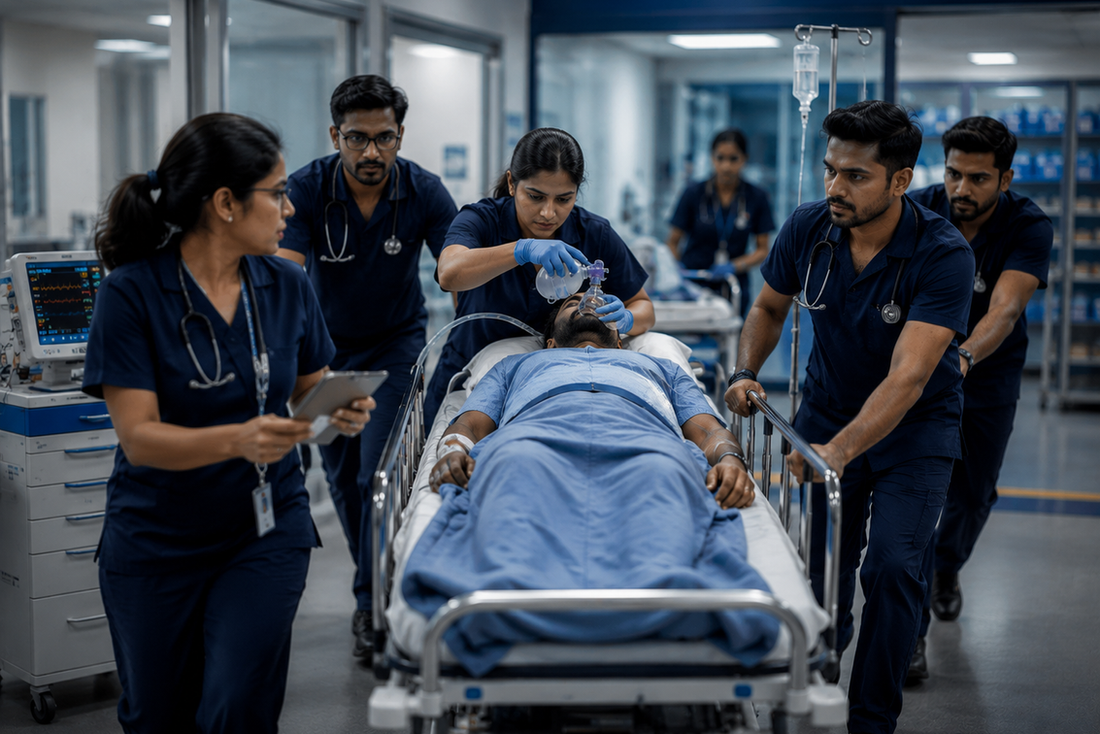
Department-Specific Emergency Drills

Best for
Speciality units needing targeted response training.
Includes
Customised scenarios for unit-specific risks and emergency workflows.
Suitable for
OBGY, ICU, dialysis unit, outpatient collapse, orthopaedic trauma, airway emergencies, ward cardiac arrest, paediatric/geriatric response where applicable.
What the institution receives

Tangible records for training, debriefing and quality review.

Final deliverables vary depending on programme duration, participant profile, institutional requirements and training scope.

attendance records
participant list
skills checklist
drill observation sheet
simulation participation record
debrief summary
readiness gap observations
crash cart readiness notes
recommendations for improvement
completion certificate / participation documentation where applicable
customised training report for institutional records
How we engage

A three-phase partnership — not a one-day workshop.

01

Assess

Walk-through, competency mapping and drill benchmarks reveal where seconds are being lost.

02

Train

Layered curricula — from Jeevan Rakshak awareness to CCLS certification — delivered on-site with high-fidelity simulation.

03

Sustain

Recurring drills, refreshers, dashboards and audit-ready records that keep readiness measurable.

AFAI simulation training in a hospital
Why hospitals choose AFAI

Simulation-based, behaviourally-informed, audit-ready.

  • IRCF-authorised Comprehensive Resuscitation Training Centre
  • Faculty with active ICU and emergency-medicine practice
  • Documentation support for NABH-readiness and internal quality review
  • On-site delivery — we bring the manikins and monitors
Example: Jeevan Rakshak Clinical Response Training Programme

A 6-month hospital staff training programme focused on clinical response.

AFAI conducted the Jeevan Rakshak Clinical Response Training Programme for hospital ICU, OT, ward nursing staff, and doctors as a continuous training model rather than a one-time workshop.

Programme model

It included hands-on training, emergency response protocols, simulation-based drills, revision sessions, reinforcement, assignments, feedback, and periodic assessment.

6-month cycle
44 participants
91.72% average attendance

Training areas included

  • Basic Life Support
  • advanced cardiac emergency response concepts
  • initial patient assessment
  • vitals monitoring and interpretation
  • recognition of deterioration
  • oxygen therapy
  • airway basics
  • hypoxia and shock response
  • tachyarrhythmia and bradyarrhythmia response
  • stroke recognition
  • choking response
  • cardiac arrest response
  • simulation-based team drills

Programme examples are presented only in aggregate form. AFAI does not publish participant names, individual marks, internal observations, private hospital weaknesses, or unedited report pages.

Ready when you are

Request a customised hospital emergency-readiness plan.

Share your departments, participant count, readiness goals and documentation needs — we usually respond within 2 working days.